
In heavy industrial and marine engineering, the service life of a steel structure is rarely determined by the strength of the steel itself, but by the quality of its surface preparation and protective coating. Recently, we completed the fabrication and coating of a batch of rolled shell plates for the Fiji Petroleum Storage Tank Project. These plates will be used to construct large petroleum storage tanks, and their coating system directly impacts operational safety and maintenance costs for decades to come.
From Bare Steel to Finished Product: Before and After Coating
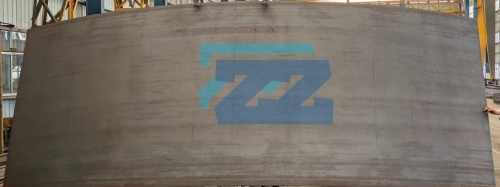
Before entering the coating workshop, these plates had just completed the rolling process, showing the original metallic finish with visible fabrication marks. As shown below, this is the Before Coating state:
After complete surface preparation and coating application, the same plate presents a uniform white coating, smooth and defect-free. This is the After Coating state:
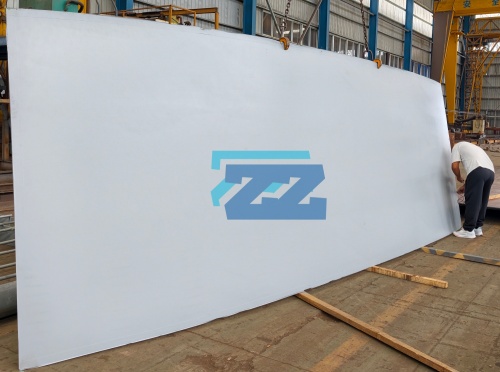
Same logo, same geometry, but a completely different service life. Coating is not merely a cosmetic change; it is the critical process that extends the steel’s service cycle from “a few years” to “over 20 years.”
PPG Coating System Used in This Project
For the harsh environment of the Fiji Petroleum Storage tank Project (high humidity, salt spray, petrochemical media), we selected a PPG protective coating system. This system has been proven in marine engineering, offshore equipment, and tank farms. The specification is as follows:
|
Coating Layer |
Product Name | Type | Minimum DFT |
Primary Function |
|
Primer |
SIGMAPRIME® 200 | Epoxy anti-corrosive | 140 μm |
Provides cathodic protection and anti-rust base |
|
Intermediate |
SIGMACOVER™ 350 | Two-component polyamide-cured epoxy | 125 μm |
Increases film thickness, enhances barrier and chemical resistance |
|
Weld Margin |
No coating | Bare steel | 50 mm |
Ensures field weld quality, prevents coating burn-off |
Data Interpretation:
Total DFT: The combined minimum dry film thickness of primer and intermediate reaches 265 μm, far exceeding general industrial anti-corrosion standards.
Weld Margin: A 50 mm bare steel margin is maintained around all weld edges to ensure no coating interference during field welding, preventing porosity and slag inclusion.
Quality Control: No Shortcuts
During the coating process, we implemented strict quality control procedures to ensure every plate meets design specifications. Here are the key measures we do not skip:
- Surface Profile Check: Before coating, the steel surface is blast-cleaned, and the surface profile is inspected. Only when the specified anchor pattern depth is achieved can the coating obtain proper adhesion.
- Multi-Point DFT Readings: After coating, dry film thickness readings are taken at multiple spots per plate, not just one. This ensures uniform coating thickness and prevents early corrosion due to thin spots.
- Extra Attention on Edges and Seams: Curved plates are prone to sagging or thin coating, especially at edges and seams. We pay extra attention to these areas to ensure complete coverage.
- Weld Zone Protection: The 50 mm weld margin must remain clean. Any overspray here causes problems during subsequent welding. We use masking protection to ensure this area remains free of paint.
Coating Is Not a Finish—It’s a Service Life Investment
These rolled shell plates will be used to build Petroleum Storage tank . In the petrochemical industry, corrosion leakage from tanks can lead to serious safety incidents and environmental pollution. The coating here is not a decorative “topcoat”—it is a critical component of structural integrity.
If DFT requirements are ignored to meet deadlines, or surface preparation steps are skipped, the owner may face corrosion perforation, maintenance shutdown, or even full tank replacement costs five years down the road. Therefore, we always treat anti-corrosion coating as a key part of the tank’s Life Cycle Cost (LCC) management.
FAQ
Q1: Why keep a 50 mm bare steel margin at weld edges?
A: The high heat of welding burns off coatings. If overspray enters the weld, it can cause porosity, slag inclusion, and lack of fusion. A 50 mm uncoated margin ensures field weld quality and avoids extra costs for post-weld coating repair.
Q2: What are the roles of SIGMAPRIME® 200 and SIGMACOVER™ 350?
A: SIGMAPRIME® 200 is an epoxy anti-corrosive primer that directly contacts the steel, providing cathodic protection and a anti-rust base. SIGMACOVER™ 350 is a two-component polyamide-cured epoxy intermediate that increases total film thickness and enhances barrier and chemical resistance. Combined, they provide a total DFT of at least 265 μm.
Q3: Why measure DFT at multiple points instead of just one?
A: When spraying curved plates, film thickness at edges, welds, and corners often differs from flat areas. A single reading cannot represent the uniformity of the entire plate. Multi-point measurement helps identify thin areas and prevents localized early corrosion.
Q4: How many years of corrosion protection can this PPG system provide?
A: With proper surface preparation, DFT control, and regular maintenance, this system typically achieves over 20 years of corrosion protection in marine and heavy industrial environments. Actual service life depends on environmental corrosivity, operating temperature, and mechanical damage.
Q5: What international standards are commonly followed for tank coatings?
A: Common standards include ISO 12944 (protective paint systems for steel structures), SSPC (The Society for Protective Coatings), and NORSOK M-501 (Norwegian offshore industry standard). The specific choice depends on owner specifications, environmental category, and media conditions.
Q6: What if the weld margin accidentally gets coated?
A: If overspray is found on the weld margin, it should be thoroughly removed by mechanical grinding or solvent wiping before welding, until clean steel is exposed. Never weld directly over a coated area.
Industry Exchange: What Coating Standard Does Your Tank Project Use?
In storage tank and large vessel projects, different owners and design institutes have different requirements for coating systems. Some prefer pure epoxy systems, some use epoxy + polyurethane topcoats, and others require glass flake or sacrificial anode protection.
We are curious: In your storage tank or vessel projects, what coating specification are you currently holding to? Are you following ISO 12944, SSPC, or another standard? Feel free to share your experience in the comments.